Impact of long-acting injectable aripiprazole on the concomitant medication and antipsychotic polypharmacy: a retrospective, observational study of 127 patients with psychosis
- Journal
- International Clinical Psychopharmacology
- Vol
- 39(4)
- Page
- 250-256
- Year
- 2024
Antipsychotic polypharmacy (APP) has become prevalent
over the years, but several concerns have been raised
over APP. Accumulating evidence suggests that
aripiprazole long-acting injectable (LAI) may reduce the
rate of APP, but the association remains speculative. This
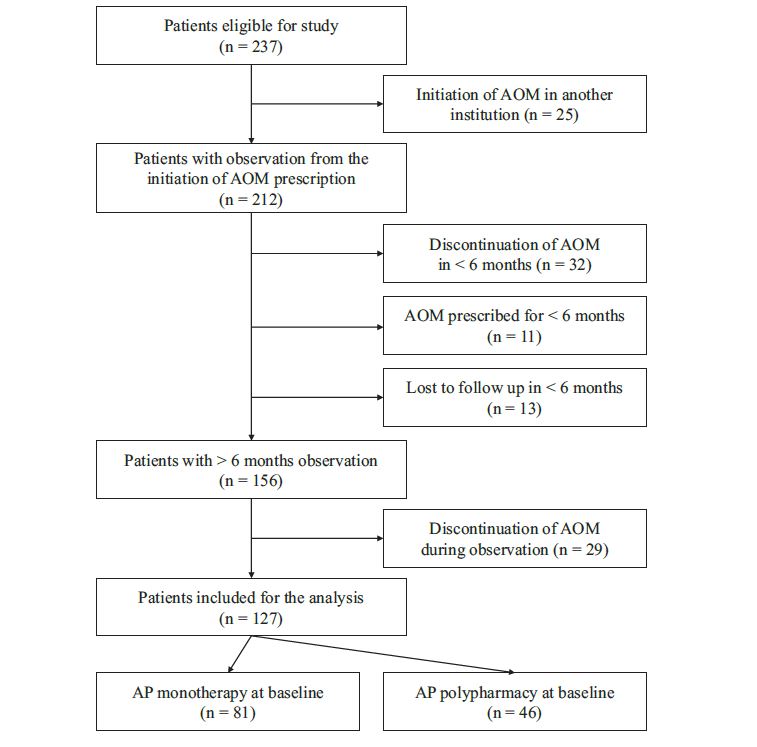
retrospective observational study included 127 patients
with psychosis and observed them for 1.8 ± 1.3 years, up
to 4 years. Prescription data of antipsychotics (APs), mood
stabilisers, benzodiazepines, and anti-extrapyramidal
side effect medications were obtained at baseline and
the last observation. Daily chlorpromazine equivalent
(CPZ) dose of APs decreased from 124.40 ± 235.35 mg
to 77.95 ± 210.36 mg (P = 0.027). The daily dose of
anticholinergics and beta-blockers also significantly
decreased after introducing aripiprazole LAI. Among the
patients having APP, the number of concurrent APs along
with daily CPZ dose of APs decreased after initiation
of aripiprazole LAI from 1.28 ± 0.62 to 0.85 ± 0.73 (P <
0.001) and 298.33 ± 308.70 mg to 155.43 ± 280.53 mg (P
= 0.004), respectively. Treatment with aripiprazole LAI for